
Here’s the situation CISOs are facing at enterprise organization. You need to carefully balance the need for employees’ timely access to sensitive data with robust data security and governance. This continues to be a significant challenge for organizations navigating through the complexities of digital transformation today, and particularly for those eager to responsibly deploy enterprise grade GenAI org-wide. It’s true there are a lot of tools out there offered by other vendors and their ecosystems that can help enterprise organizations achieve similar outcomes, or strike this balance. In this blog post I’ll focus on what I believe are the greatest advantages of Microsoft Purview to CISOs of enterprise orgs trying to strike this balance, beyond just the fact that it natively integrates the capabilities and features that I covered in a previous post on demystifying Microsoft Purview.
Here are the 5 greatest advantages of Microsoft Purview for enterprise orgs:
1. A unified, coherent experience and operating model for Data Security:
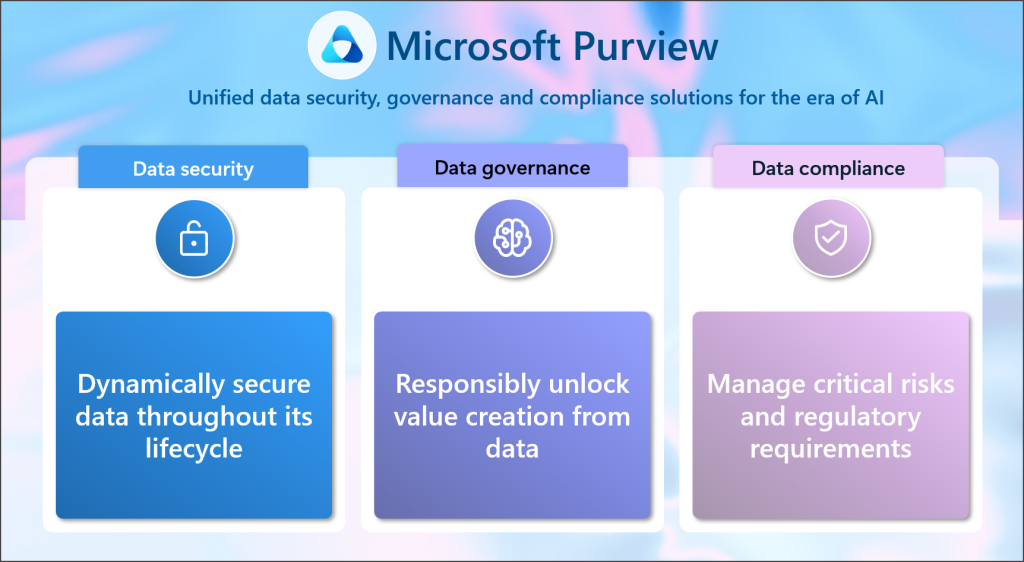
An all-in Purview strategy gives CISOs a unified way to manage data security, compliance, and governance rather than having your teams orchestrate separate consoles, taxonomies, policy engines, and reporting models. The Microsoft Purview portal provides a unified experience for data security, data governance, risk and compliance, with a common entry point for settings, search, roles, and permissions management. In Forrester Consulting’s Microsoft-commissioned Total Economic Impact of Microsoft Purview study, organizations improved security personnel efficiency by 75%, reduced manual compliance effort by 60%, and reduced end-user data discovery and access time by 75% after deploying Microsoft Purview.
Why this matters: it’s not just an advantage aligned to Board directives to simplify/streamline your technology stack to derive greater operational efficiencies… this is also a cost reduction advantage.
2. Native protection and integration across Microsoft365, where employees already work:
Microsoft Purview’s strongest advantage for a Microsoft 365 E5 organization is that controls are embedded right within your main productivity platform. Whether on Windows or MacOS devices, user-facing apps like Outlook, Word, Excel, PowerPoint, SharePoint, OneDrive, Teams, Fabric and Power BI, and even Microsoft 365 Copilot all benefit from Purview capabilities such as Data Loss Prevention, and others. Microsoft Purview Information Protection’s sensitivity labels are a foundational capability that provides protection actions (including content markings on label application, encryption and access restrictions) that feed signals to other Purview capabilities like Insider Risk Management to further improve your proactive data security posture.
Why this matters: Compared with a multi-vendor patchwork stack, this reduces the need to bolt policy enforcement onto the environment after the fact. Users experience the benefits of these controls inside the tools they already use. This drives stronger adoption and helps make security a ‘team sport’.
3. Enhanced SecOps through better integration and incident context:
Microsoft Purview can help move data security events closer to your SOC. Microsoft Defender XDR can ingest signals from Microsoft Purview Data Loss Prevention and Insider Risk Management to natively coordinate detection, prevention, investigation, and response across endpoints, identities, email, and applications. To further the point, the close integration between Defender XDR and Sentinel feeds Defender incidents and advanced hunting events into Sentinel and keeps incidents synchronized between the portals. Separately, Microsoft Purview’s integration with Sentinel helps provide visibility into where sensitive information is stored, help prioritize at-risk data, and combine Purview and audit logs with other data for enriched insights.
Why this matters: better integration means faster detection, investigation, and response to data-related threats.
4. Reduced administrative and vendor management overhead:
A generic multi-vendor approach can work, but it typically increases integration, procurement, support, skills, and lifecycle-management complexity. Gartner’s consolidation research states that organizations consolidate security solutions for reasons including lower total cost of ownership through efficiencies, improved security posture through better integration and coverage, and easier procurement. Forrester’s Purview Total Economic Impact study found that the composite organization could retire legacy records management and data security tools, avoiding licensing, infrastructure, and management costs, with legacy cost avoidance modeled at roughly $498,000 present value over three years. The main point here isn’t about a guaranteed savings figure; it is the reduction of redundant tools and operational friction.
Why this matters: Lower operational burden, simplified governance without product-specific siloes are important outcomes by themselves. Add to that the improved return on investment with Microsoft 365 E5, and this becomes rather reassuring to most cost-conscious enterprise organizations, particularly when considering these are industry-leading capabilities to begin with.
5. A stronger foundation for AI readiness and Governance:
Microsoft Purview provides foundational relevance, because AI governance depends on data governance. Microsoft Purview’s Data Security Posture Management helps discover, protect, and investigate sensitive data risks across the digital estate, including traditional applications GenAI and AgenticAI. Microsoft 365 Copilot operates within the Microsoft 365 service boundary and respects existing data protection, access control, and compliance capabilities. This means it works with Purview sensitivity labels and encryption, and Copilot interaction data can be audited, retained, and discovered using Purview capabilities. Forrester’s composite model also attributes a 30% improvement in data security to Microsoft Purview, reflecting improved visibility into external and insider threats and more fine-tuned DLP policies.
Why this matters: Simply put? Greater confidence in “responsible” AI adoption because it reduces the risk of sensitive data exposure that most organizations who are rushing to adopt AI – without addressing these risks – are facing today.
One more thing (a bonus advantage, if you will):
The fact that Microsoft Purview is a product that’s owned and under continuous development by one of the dominant players in the software space does create an advantage for you. You may have your own opinions to what degree this is a proper advantage like the ones I’ve laid out above, but my lens on this is Purview isn’t some flavor of the month tool from some YComb startup that’s ripe for a hedge fund to scoop up, “enshittified”, and sold for spare parts to the highest bidder. It’s here to stay and backed by an industry leader consistently in Gartner and Forrester recommendations, it continues to benefit from ongoing feature development, etc.
In all of that lies some planning stability. If you’re like most CISOs, you probably don’t have much capacity to be pitched some new tool that does one niche thing spectacularly well (and costs its own arm and a leg). Certainly not while you’re contending with evolving realities for people, processes, and technology you’re responsible for overseeing. Your organization is most likely in a position to genuinely benefit from a unified, coherent experience for administrators (without costly integration complexities) that allow you to strike that balance between enabling end-user productivity and ensuring your data is secure, governed, and compliant to regulatory requirements. This may be even more true for you if you’re facing cost pressures to streamline your Data Security toolset. In most cases these capabilities are included within the same E5 license tier that many enterprise organizations are already on*.
*Note: full disclosure that there are a fair number of capability/feature refinements coming down the product pipeline that fall within the pay-as-you-go category. These do incur additional costs that organizations are struggling to meaningfully forecast at present. Only time will tell whether the traditional cost-saving angle continues to have merit in the future as it has in the past. It certainly does at present, with all things considered.
Thanks for reading, and please reach out if you’d like to discuss the practical next steps you can take… or if you have a question and just want to chat more!